Officials from FAA, Microsoft, U.S. banks, National Security Agency blame technical glitches
First, Microsoft platforms went down.
Next, thousands of flights were grounded across the U.S. over an air traffic control communications outage.
Then, customers of three major U.S. banks couldn’t use their accounts online and United Airlines reported a widespread problem with its system for managing flight departures.
The latest? The classified internal communications network of the National Security Agency — whose mandate includes protecting government communications networks — went offline on Tuesday.
In all cases, officials are blaming the outages on technical glitches, saying there’s no evidence of cyberattacks.
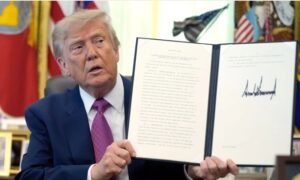
Asked Tuesday by a reporter if he’s concerned about the outages, U.S. President Donald Trump brushed off the question.
“No, it’s life,” Trump said at the Asia-Pacific Economic Cooperation summit in Manila. “When you’re big and powerful and you have all the money, things like that happen. It’s fine.”
U.S. Secretary of State Marco Rubio said there was no suggestion the outage events were related to one another or to some kind of opponent.
“We have zero evidence or any reason to believe that any of these isolated or individual instances have anything to do with nefarious actors, with cyber hackers, with criminals, with another nation state, with a malign actor of any kind,” he said Tuesday.
Despite Trump’s reassurance that everything’s fine, there are plenty of Americans asking what the heck is going on, including experts like Michael Allen, who served as special assistant for national security to former president George W. Bush.
The successive outages are “a bit fishy,” Allen, who is managing director of Beacon Global Strategies, a Washington D.C. firm that advises companies on national security issues, told CNN on Tuesday.
“It really makes me wonder how secure United States infrastructure is, especially in an age of artificial intelligence when it’s much easier to be able to find vulnerabilities inside of computer networks than it used to be.”
‘These developments are troubling’
In Washington, the top Democrat in the U.S. House of Representatives, Hakeem Jeffries, also has questions.
“These developments are troubling and it’s unclear if it’s all infrastructure related or whether there’s some malignant activity,” Jeffries told reporters on Capitol Hill Tuesday.
“I think it’s time for the administration to come up to the Hill and explain themselves so we can be informed about the steps that need to be taken.”
Jeffries said he’s particularly interested in finding out more about what triggered the Federal Aviation Administration to order Friday’s nationwide ground stop of flights.
“There are still more questions than answers in terms of what happened, why it happened, how do we prevent it from happening again,” Jeffries said.
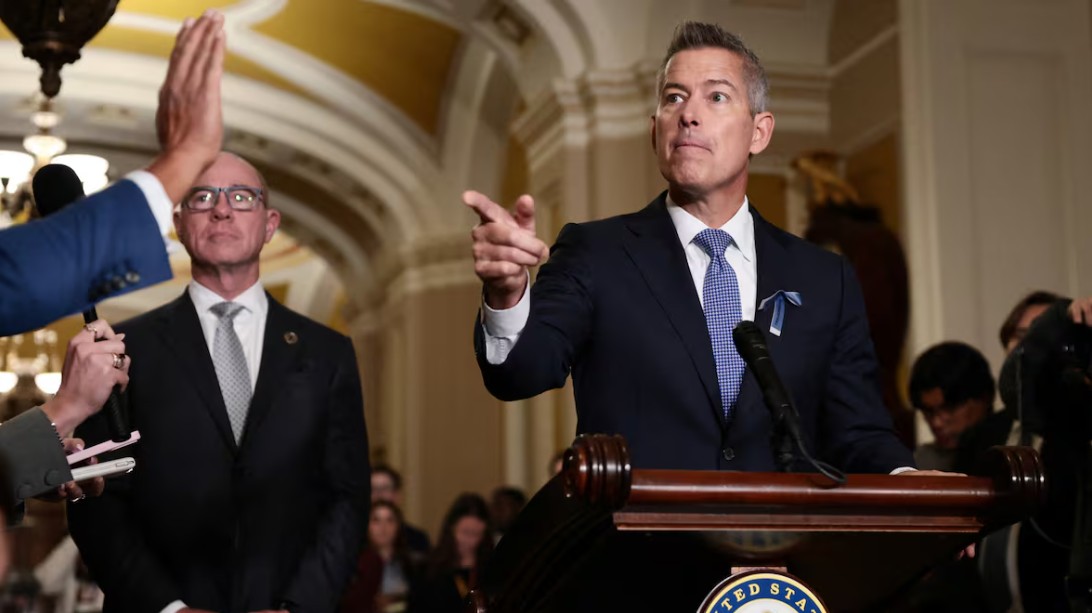
U.S. Transportation Secretary Sean Duffy has pinned the blame on a newly installed router overloading the national air traffic control’s communication system, causing intermittent gaps in radar coverage and communication with pilots.
Duffy promises answers on router
“The root cause of what happened, we don’t have clarity as of yet,” Duffy told reporters on Capitol Hill Tuesday.
“When I know what happened with that router, injecting that overload into our system, I will most definitely share that with you,” he said.
“If we were subject to a hack, we will share that you as well, but all of my intelligence partners are telling me that wasn’t the case.”
Bryan Bedford, the FAA administrator, shut down as “completely unfounded” speculation that the outage was connected to the agency’s launch last week of an AI tool for feeding analysis of flight traffic data to its controllers.
The FAA ground stop, which led to the cancellation of around 20,000 flights from Friday to Sunday, was only the most visibly disruptive technology glitch of the past week.
On Tuesday, the National Security Agency’s system for sending and receiving classified information went down.
The NSA outage was blamed on “temporary degradation during scheduled routine maintenance,” according to a statement from a spokesperson.
“While some internal systems were affected, mission-critical capabilities remain fully operational and our ability to defend national security continues,” the spokesperson said on Tuesday.
United Airlines pilots told air traffic controllers that the outage that triggered departure delays for more than 100 flights on Monday was related to a system that helps them determine a plane’s final weight.
“There is no indication that this was a cybersecurity-related issue,” United said in a statement.
Monday’s banking problems began with what JPMorgan Chase officials called “a temporary issue related to a software bug,” which then rippled through the financial system, also affecting customers of Bank of America and Wells Fargo.
JPMorgan Chase, the biggest bank in the U.S., also denied that a cyberattack was to blame.
Meanwhile, Microsoft said the outages that hit its email and video-conferencing services last week were not the result of a cyberattack or rogue AI agents, but instead an unspecified issue with what the company described as a “network capacity upgrade.”
Source : cbc.ca