President’s social media post comes amid Canada’s counter-tariff plans, broken trade talks
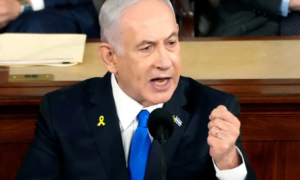
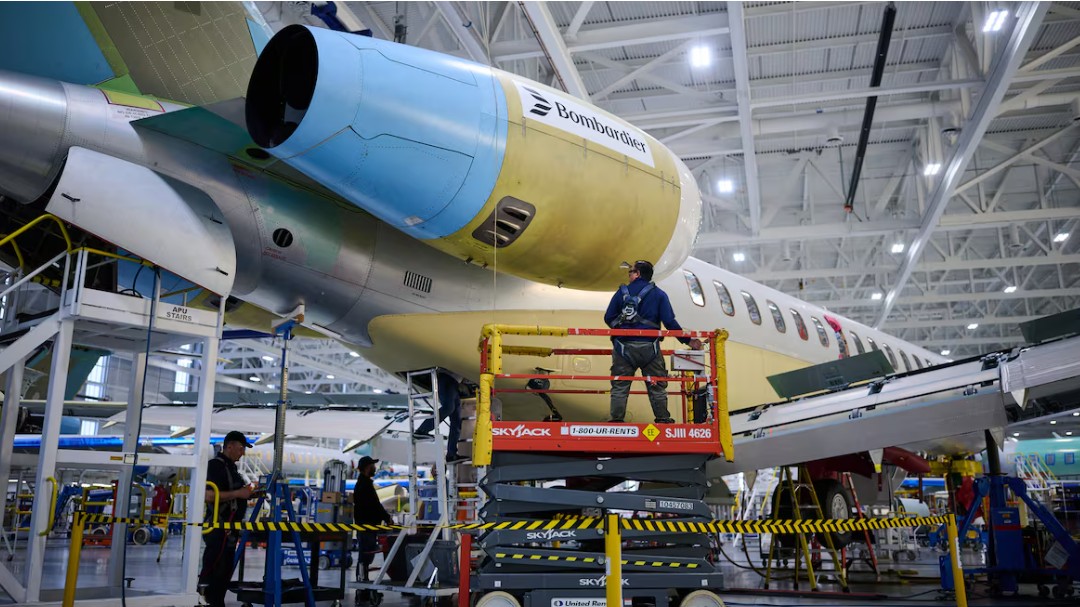
U.S. President Donald Trump said Monday that Montreal-based airplane maker Bombardier would no longer be allowed to sell in the United States unless it starts manufacturing in the states.
“NO MORE SELLING BOMBARDIER IN THE UNITED STATES! Their products aren’t good enough!” Trump said in Truth Social post.
“If they want our Market, they must build here, and stop treating America like a ‘piggybank.'”
Trump’s post, which comes amid a growing trade dispute between Washington and Ottawa, was the latest salvo in his campaign to pressure foreign and domestic companies to manufacture more products in the U.S.
That objective has driven many economic policies in his second term, especially a near global tariff wall that has drawn complaints from many U.S. trading partners.
Canada is set to introduce a wave of counter-tariffs against the United States early Tuesday.
Bombardier ‘a source of pride,’ premier says
Quebec Premier Christine Fréchette said on social media on Monday that she won’t respond to Trump’s provocations with more provocations.
“Bombardier is a source of pride for Quebec, a flagship of our economy, and a major player in our aerospace industry. Behind this company are thousands of Quebec workers who showcase our expertise around the world,” she wrote in French.
“I have reached out to Eric Martel, CEO of Bombardier, to offer him our full support.”
The White House didn’t immediately respond to a request for comment on how Trump would enforce the action targeting Bombardier or the steps he would take to bar deliveries of Bombardier jets that have been approved by the U.S. Federal Aviation Administration (FAA).
The company’s jets also comply with the Canada-United States-Mexico Agreement (CUSMA) trade deal that Trump helped implement.
Company already building in U.S.
Bombardier issued a statement late Monday highlighting the work it already does in the U.S., as well as plans for expansion, saying its aircraft create “tens of thousands of U.S. jobs.”
“Bombardier values its great partnership with American companies and its U.S. employees. Our plan is to continue to invest in our people, our customers and the communities in which we operate across the country,” the statement said.
U.S. aerospace analyst Richard Aboulafia said he didn’t believe any business jet customers would cancel Bombardier orders and didn’t see how Trump could stop them from being sold.
Aboulafia said most Bombardier private jets use U.S. engines, which are produced by Honeywell Aerospace and GE Aerospace.
Aerospace has largely emerged unscathed from the tariff war, with the flow of parts and planes not currently impacted by duties. According to U.S. trade group Aerospace Industries Association, the country’s aerospace and defence sector has a $109.2 billion US trade surplus, with exports up 25 per cent on an annual basis in 2025.
Like the U.S. auto sector, which depends on Canadian parts production, aerospace is highly integrated on a global scale.
Bombardier, the rival of U.S. business jet manufacturer Gulfstream Aerospace, has an American workforce of 3,500 and a U.S. footprint of 2,800 suppliers, along with factories and service centres in the country. The company is now adding its sixth U.S. service centre and produces wings for its flagship Global 8000 jet in Texas.
Bombardier also has a defence division with a U.S.-based factory, in Kansas, where it prepares planes for special mission purposes. About half of the fleet of 5,100 aircraft operated by Bombardier customers are located in the U.S.
In January, Trump said the U.S. was decertifying Bombardier Global Express business jets and threatened 50 per cent import tariffs on all aircraft made in Canada until the country’s regulator certified a number of planes produced by U.S. rival Gulfstream. Neither occurred, but the following month, Canada certified several Gulfstream planes.
Bombardier announced on Sept. 1 that it would acquire a Canadian factory from supplier Mitsubishi Heavy Industries, which manufactures wings for the private jet maker’s Global 5500 and 6500 aircraft.
In July, Bombardier reported that its quarterly revenue grew six per cent compared with the same three months a year ago to $2.15 billion U.S., helped by strong demand for aftermarket services.
Bombardier ‘first of many’ targets: expert
John Gradek, a faculty lecturer in supply chain networks and aviation management at Montreal’s McGill University, says he’s not sure Trump has put “a lot of thought” into what barring Bombardier planes would mean for U.S. citizens and the company’s U.S. employees.
Nonetheless, he suspects Trump will turn his attention to other Canadian companies as the trade dispute continues, saying the plane maker will be the “first of many” targets.
“He’s taking a shot at a company that has been very successful in attracting U.S. buyers, and he thinks by doing that, he will in fact spread ruin on the Canadian economy,” Gradek said, adding that he hopes Canada considers retaliatory action.
“There are many other very successful Canadian companies operating in the U.S. I’m not sure who the next target will be, but there will be others.”
Source : cbc.ca